
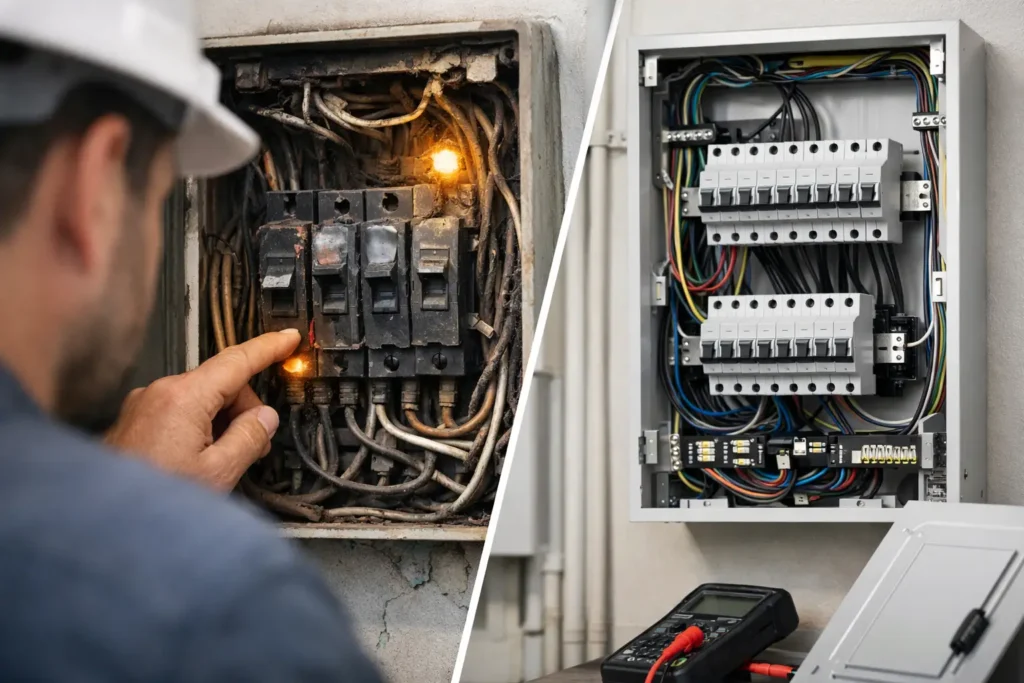
A panel that trips once after a heavy load is not always a replacement case. A panel that trips repeatedly, feels warm, shows corrosion, or cannot support the equipment your property now relies on is a different matter. Knowing when to replace electrical panels helps property owners and facility teams prevent unplanned downtime, protect equipment, and address electrical risks before they become disruptive repairs.
The electrical panel is the control center for a building’s electrical system. It distributes power to circuits, provides overcurrent protection, and allows electrical work to be isolated safely. Because it works quietly in the background, it is often overlooked until breakers start tripping or an expansion project exposes a lack of capacity.
When to Replace Electrical Panels Instead of Repairing Them
A qualified electrician should assess the panel before a replacement decision is made. Some concerns, such as a loose breaker, damaged circuit, or mislabeled directory, may be repairable. Replacement becomes the more practical option when the enclosure, bus bars, breakers, or overall capacity no longer provide safe, dependable service.
For commercial and industrial properties, the decision also involves operational risk. A panel may still be functioning, but if a single failure could shut down retail operations, office systems, refrigeration, production equipment, or critical tenant services, waiting for a complete failure can cost more than planning an upgrade.
1. Breakers Trip Frequently or Will Not Reset
Circuit breakers are designed to trip when a circuit is overloaded or a fault occurs. Occasional tripping can happen when too many high-demand appliances run on one circuit. Frequent tripping, however, requires investigation.
If a breaker trips with normal use, will not reset, or trips again immediately, the cause could be an overloaded circuit, a short circuit, faulty equipment, damaged wiring, or a failing breaker. Replacing a breaker may solve a limited issue, but widespread breaker problems can point to an aging or overloaded panel. Do not keep resetting a breaker to restore power. The repeated trip is a warning that needs professional diagnosis.
2. The Panel Is Warm, Makes Noise, or Smells Burnt
A properly operating electrical panel should not feel hot to the touch. Warmth around breakers, a buzzing or crackling sound, a burning odor, smoke marks, or discolored plastic can indicate loose connections, arcing, overheating, or internal damage.
These conditions call for urgent attention. Turn off power only if it is safe to do so and arrange an immediate inspection by a licensed electrical professional. Avoid opening the panel cover or touching internal components. Electrical arcing can create fire and shock hazards even when the issue seems limited to one circuit.
3. There Is Visible Rust, Water Damage, or Corrosion
Water and electricity do not belong in the same enclosure. Moisture can enter panels because of plumbing leaks, roof leaks, condensation, flooding, exterior exposure, or poor sealing around conduits. Over time, corrosion can affect terminals, breakers, bus bars, and the panel enclosure.
A surface stain does not always mean the entire panel must be replaced, but visible rust inside the enclosure, corroded components, or any history of flooding deserves a full assessment. The source of moisture must be corrected as part of the work. Replacing a damaged panel without fixing the leak only repeats the problem.
4. The Panel Has No Space for New Circuits
Properties change. A home may add an electric range, EV charger, workshop equipment, or air conditioning. A commercial space may add workstations, kitchen equipment, signage, security systems, servers, or new tenant improvements. Each addition increases electrical demand and may require dedicated circuits.
If every breaker position is occupied, avoid the temptation to crowd the panel with inappropriate components or rely on extension cords and temporary power solutions. A subpanel may be a practical option in some situations. In others, especially where service capacity is also limited, replacing the main panel is the cleaner long-term solution.
5. Lights Flicker and Equipment Loses Power
Lights that dim or flicker when equipment starts may indicate a normal load change in limited cases, but persistent or widespread flickering should not be ignored. The same applies to outlets that lose power, electronics that restart unexpectedly, or motors and HVAC equipment that perform inconsistently.
The issue may originate at a circuit, panel, service connection, or utility supply. A professional inspection can isolate the cause. For facility managers, documenting when the problem happens and which equipment is operating at the time can speed up troubleshooting and help determine whether a panel upgrade is necessary.
6. The Panel Is Undersized for the Property’s Current Load
Older buildings were not designed around today’s electrical use. A panel that was adequate decades ago may struggle with modern appliances, larger HVAC systems, electric vehicle charging, high-density office technology, or specialized business equipment.
Panel size is only one part of the equation. The electrician must evaluate the electrical service, feeder conductors, connected loads, demand calculations, grounding, and the capacity available from the utility. Installing a larger panel does not automatically increase the incoming service. A proper upgrade plan makes sure the full system can support the expected load safely and in line with applicable code requirements.
7. The Panel Contains Obsolete or Problematic Equipment
Some older panel brands and breaker types have known reliability concerns or may be difficult to service because compatible replacement components are no longer readily available. If a panel has been recalled, damaged, modified improperly, or fitted with mismatched breakers, replacement is often the best path.
This is not a situation for guesswork based on the panel’s appearance alone. A licensed electrician can identify the equipment, confirm whether it has known concerns, and recommend an appropriate replacement. For landlords and property managers, this review is especially useful before purchasing a property, renewing a major lease, or starting a renovation.
8. You Are Renovating, Expanding, or Changing the Building Use
Electrical upgrades should be considered early in a renovation rather than after walls are closed and finishes are installed. New layouts can change outlet locations, lighting loads, HVAC requirements, fire and life-safety systems, and equipment needs. A former storage area converted into offices, a retail space converted into food service, or a home garage converted into a workshop can all require a different electrical design.
Planning the panel work alongside fit-out, civil, HVAC, and plumbing activities reduces rework and helps keep the project schedule under control. It also provides a better opportunity to label circuits clearly, organize distribution points, and allow room for reasonable future expansion.
What a Professional Panel Assessment Should Cover
Before recommending replacement, an electrical contractor should inspect more than the front cover. The assessment should review the panel condition, breaker operation, signs of heat or corrosion, circuit loading, grounding and bonding, labeling, available spaces, and visible wiring concerns. Where appropriate, the contractor should also evaluate the incoming service and discuss current and planned equipment loads.
The result should be a clear recommendation: repair a specific issue, add circuits or a subpanel, upgrade the main panel, or coordinate a broader service upgrade. The right answer depends on the building, its usage, code requirements, and the expected growth of the electrical load.
For properties with multiple maintenance needs, coordinated planning matters. Electrical work can affect walls, ceilings, HVAC controls, access routes, and cleaning requirements after construction. Working with one responsive facilities support partner can reduce vendor coordination and make it easier to schedule inspections, repairs, and follow-up work around business operations.
Do Not Wait for a Complete Failure
A failed panel rarely happens at a convenient time. It can interrupt tenants, damage sensitive equipment, delay a fit-out project, and create emergency repair costs. Routine inspections and prompt attention to warning signs give owners and operations teams more control over timing, budget, and site safety.
If your panel is showing heat damage, water exposure, repeated trips, limited capacity, or unreliable performance, arrange a professional electrical inspection. A planned replacement is not just an electrical upgrade – it is a practical step toward safer operations and fewer avoidable disruptions.