
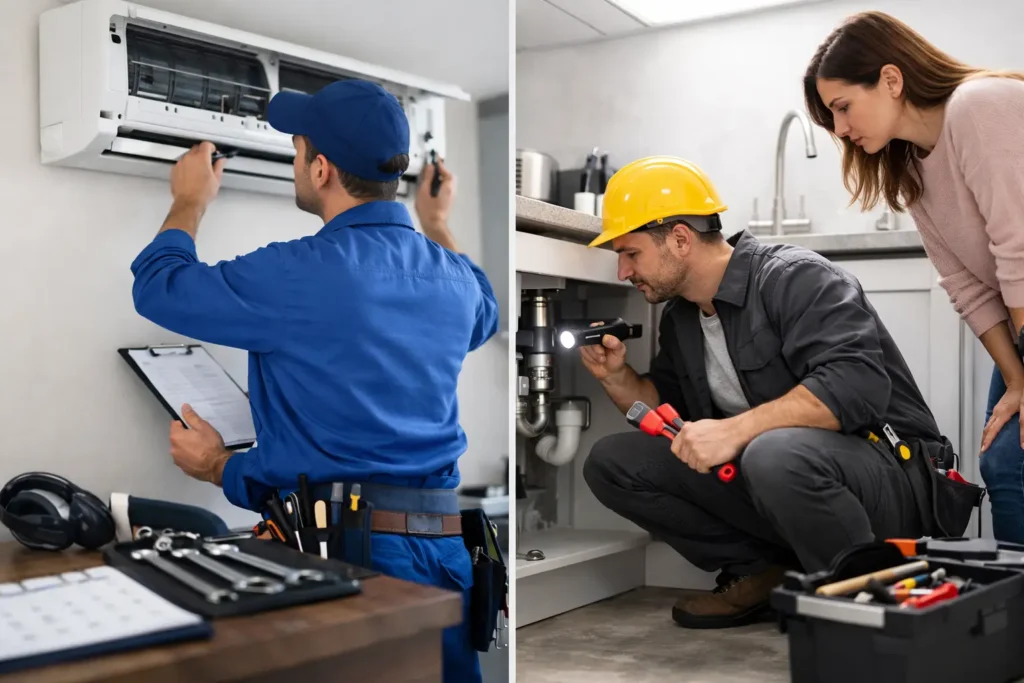
A leaking pipe at 2 a.m., an AC failure during business hours, or a tripped electrical circuit before tenants arrive can quickly turn a small fault into a costly disruption. The choice between an annual maintenance contract vs on demand service determines how quickly your property is supported, how predictable your costs are, and how much time your team spends coordinating contractors.
For property owners, facility managers, landlords, and operations teams, neither option is automatically right. The better choice depends on the type of property, the condition of its systems, occupancy levels, compliance requirements, and the level of response your operations need.
What Is an Annual Maintenance Contract?
An annual maintenance contract, often called an AMC, is an ongoing service agreement for planned and corrective property maintenance. Rather than calling a different contractor every time an issue appears, you work with one provider under agreed service terms for a defined period, usually one year.
The scope can include routine inspections, preventive maintenance visits, emergency callouts, and repairs across selected services. For a commercial building, that may cover HVAC servicing, electrical checks, plumbing maintenance, handyman work, cleaning support, and minor civil repairs. For a residence, it may focus on air conditioning, plumbing, electrical systems, and general home upkeep.
The main value is continuity. Your service provider becomes familiar with the property, its equipment, recurring issues, access procedures, and operational priorities. That knowledge helps reduce delays when work is needed.
What Does On-Demand Maintenance Mean?
On-demand maintenance is a pay-as-you-go approach. You contact a service provider when a repair, installation, cleaning task, or maintenance need arises. The work is quoted and scheduled based on the issue, labor needs, materials, and technician availability.
This option works well when maintenance needs are infrequent or highly specific. A property owner may only need a one-time deep clean after renovation, a replacement water heater, an electrical installation, or a repair to a single damaged fixture.
On-demand service gives you flexibility because there is no recurring contract commitment. However, it also means each request starts with a new scheduling, assessment, quotation, approval, and coordination process. During a busy period or urgent situation, that process can affect response time.
Annual Maintenance Contract vs On Demand: The Practical Difference
The key difference is not simply fixed cost versus individual invoices. It is planned property care versus reactive service purchasing.
With an AMC, inspections and scheduled maintenance can identify developing faults before they interrupt operations. A technician may find a blocked drain, worn electrical component, deteriorating seal, or declining AC performance during a routine visit. Addressing it early is usually less disruptive than waiting for a breakdown.
With on-demand service, work begins after a need is reported. This is appropriate for isolated issues, but it can become expensive and inefficient when the same property repeatedly needs plumbing, electrical, HVAC, cleaning, and handyman support.
For a facility manager, the difference is often administrative. An AMC provides a single point of contact and a more organized service record. On-demand work can require multiple vendors, repeated approvals, separate invoices, and more time spent explaining the same property requirements.
When an Annual Maintenance Contract Makes Sense
An AMC is usually the stronger option for properties with active systems, regular occupancy, or a low tolerance for downtime. Offices, retail locations, apartment buildings, villas, warehouses, and industrial facilities often benefit because maintenance needs are ongoing, even when there is no visible emergency.
It is especially useful when several service categories must work together. An HVAC issue may involve electrical components. A plumbing leak may require civil repair and cleaning afterward. A centralized provider can coordinate the work without making the client manage separate trades.
An annual agreement can also make budgeting easier. While materials and major replacements may be treated separately depending on the contract, planned labor and routine visits can be organized around an agreed service model. That gives decision-makers a clearer view of expected maintenance spending.
Choose an AMC when you need dependable response, routine inspections, preventive maintenance, and fewer vendor-management tasks. It is not just for large facilities. A busy household or landlord with multiple units may also gain value from faster support and consistent service history.
The operational benefits of an AMC
The strongest benefit is reduced uncertainty. Instead of searching for available technicians after a failure, you have an established support arrangement and clear escalation process.
An AMC also improves accountability. Service visits, recurring issues, completed work, and recommendations can be tracked over time. This helps property teams make better decisions about repairs, replacements, and upgrades rather than relying on one-off assessments.
For properties that need support outside standard hours, response availability matters as much as technical skill. A maintenance partner with 24/7 support can help protect tenant comfort, business continuity, and site safety when unexpected issues occur.
When On-Demand Service Is the Better Choice
On-demand maintenance is a sensible choice for newer properties with limited service needs, vacant units, or one-time projects. If you only need occasional help and can tolerate normal scheduling lead times, a contract may not provide enough value to justify the commitment.
It is also useful for specialized work outside a standard maintenance scope. A major fit-out project, extensive renovation, large equipment replacement, post-construction cleaning, or landscaping upgrade may be better quoted as a separate project.
This model gives you the freedom to compare quotes for every task. For some owners, that feels like better cost control. The trade-off is that the lowest individual quote does not always produce the lowest annual maintenance cost. Repeat callout fees, urgent labor rates, delayed repairs, and contractor coordination can add up quickly.
On-demand service is best when your maintenance needs are genuinely occasional, your systems are in good condition, and your team has the capacity to manage service requests as they occur.
Cost Control: Look Beyond the Callout Price
Comparing only the price of an AMC against a single repair invoice can be misleading. The meaningful comparison is the total annual cost of keeping the property safe, functional, and presentable.
Reactive repairs often cost more because the issue has already progressed. A minor HVAC performance problem can become a full breakdown. A slow leak can damage finishes, create mold concerns, or affect neighboring spaces. An electrical fault can interrupt equipment or require urgent work at a premium rate.
An AMC does not eliminate every unexpected expense. Major parts, equipment replacement, accidental damage, and work outside the agreed scope may still create additional costs. A good contract should state what is included, what is excluded, visit frequency, response expectations, and how materials are approved.
Before choosing either model, request a free inspection or property assessment. It gives you a more realistic picture of current risks and helps avoid selecting a contract that is too limited or paying for emergency work that could have been prevented.
Questions to Ask Before You Decide
The right decision becomes clearer when you examine how the property actually operates. Consider how often maintenance requests occurred over the last 12 months, which systems caused the most disruption, and whether your team regularly coordinates several contractors.
Also ask whether a service provider can handle your required disciplines in-house or through a managed team. Plumbing, electrical, HVAC, civil works, handyman tasks, cleaning, sanitization, and landscape support often overlap in day-to-day property operations. Using separate vendors for every requirement may work for a small number of jobs, but it can create avoidable delays as demand grows.
Finally, review response commitments, reporting, pricing structure, service coverage, and emergency support. A contract is only valuable when the provider can deliver consistently. On-demand service is only economical when it remains truly occasional.
Choose the Support Model That Matches Your Property
An annual maintenance contract is designed for continuity, prevention, and operational control. On-demand service is designed for flexibility and isolated requirements. Many properties benefit from a combination: an AMC for essential systems and routine upkeep, with separate project quotes for major upgrades or specialized work.
Maxa Technical Services LLC helps clients organize technical, cleaning, and facilities support through one coordinated service partner. Whether your property needs planned coverage or a fast response to a specific issue, start with a clear assessment of your risks, service history, and downtime costs. The right maintenance arrangement should make property management easier long before the next emergency call.